For most vehicles on the road, a quality aftermarket windshield is a genuinely good choice — safe, correctly fitted, and meaningfully less expensive than the badged part. For a smaller group of cars, the glass you pick changes how the vehicle actually behaves. Head-up display, certain camera packages, acoustic laminates, and some sensor setups are the real dividing lines.
The problem is that most drivers get asked to choose between "OEM" and "aftermarket" without anyone explaining which group their car is in. Here's the honest version.
OEM, OEE, and aftermarket: what the three terms actually mean
These get used loosely, and sometimes deliberately blurred. The distinctions are simple.
OEM (Original Equipment Manufacturer) glass is made under contract to the automaker, to the automaker's specification, and it carries the automaker's logo alongside the glass manufacturer's mark. It is the same part your car left the factory with.
OEE (Original Equipment Equivalent), sometimes called "dealer glass" or "OEM-equivalent," is built to the same specification — frequently by the very same glass manufacturer, on the same tooling — but sold without the carmaker's branding. Physically it can be nearly indistinguishable from OEM. What you're not paying for is the logo and the automaker's distribution markup.
Aftermarket glass is produced by an independent manufacturer designing to fit your vehicle rather than to the automaker's internal spec. This is the broadest category and the one with the widest quality range: some aftermarket manufacturers produce excellent glass, and some produce parts that fit acceptably but fall short on optical clarity or feature support.
| OEM | OEE | Aftermarket | |
|---|---|---|---|
| Made to automaker spec | Yes | Yes | Manufacturer's own spec |
| Carries automaker logo | Yes | No | No |
| Feature support (HUD, acoustic, sensors) | Matches original | Usually matches | Varies by part — must be verified |
| Optical consistency | Highest | Very close | Good to excellent from strong brands |
| Cost | Highest | Middle | Lowest |
| Availability | Can require ordering | Usually good | Best, often same-day |
One thing all three share: every windshield legally sold for road use in the U.S. is laminated safety glass that must meet federal glazing safety standards. Look at the lower corner of your current windshield and you'll see the etched certification markings. The structural job a windshield does — supporting the roof in a rollover, giving the passenger airbag something to push against — is delivered by that laminate and by the urethane bond holding it in place. That part is not where OEM and aftermarket differ.
Where the difference genuinely matters
These are the situations where we will tell you the glass choice is not a preference.
Head-up display
If your car projects speed or navigation onto the windshield, the glass has a wedge-shaped interlayer engineered to make the projected image resolve as a single sharp picture. Install glass without that wedge and you get a ghosted double image every time the HUD is on. There is no adjusting your way out of it. HUD vehicles need HUD-specific glass, full stop.
The camera's optical zone and bracket
The forward-facing camera behind your mirror looks through the windshield, and it mounts to a bracket bonded to the glass. Two things have to be right: the bracket has to sit exactly where the vehicle expects it, and the glass in the camera's field of view has to be free of distortion. Small deviations in either get amplified over the distance the camera is actually judging.
Most of the time this is a non-issue and calibration completes normally. But when a calibration won't finish, the glass is one of the first things we look at — and the fix is the correct part, not more attempts. That's a big reason we do ADAS recalibration in-house with Autel equipment rather than sending you to a second shop: we find out on the same day, in the same bay, whether the part we installed satisfies the vehicle.
Acoustic interlayer
Many modern vehicles use a sound-damping layer in the laminate that noticeably cuts wind and road noise. It's easy to overlook on a spec sheet and very obvious at freeway speed on the Loop 101. If your car came with acoustic glass and the replacement doesn't have it, the car will simply sound louder — nothing unsafe, but not what you paid for. Ask specifically.
Rain, light, and humidity sensors
Sensors mounted at the top of the glass read through a small, precisely finished window in the frit. The mounting area and the optical properties there have to match, or you get wipers that trigger late, run when they shouldn't, or don't respond at all.
Embedded elements and coatings
Heated wiper-park zones, in-glass antennas, and infrared-reflective solar coatings are all features that either exist in the replacement part or don't. In Arizona, the solar coating one is worth asking about — an IR-reflective windshield does real work on a 115-degree afternoon, and losing it is a comfort downgrade you'll feel every summer.
Where the difference is mostly marketing
If your vehicle has no head-up display, no forward camera, no rain sensor, and no acoustic laminate — which describes a large share of what's parked in Phoenix driveways — a quality aftermarket windshield from a reputable manufacturer will look, perform, and last essentially like the original. Paying an OEM premium on that car buys you a logo.
There's also a point that gets lost in the OEM-versus-aftermarket argument entirely: most real-world windshield problems come from installation, not from the glass. Leaks, wind noise, stress cracks starting at the edge, and trim that never sits right usually trace back to how the opening was prepped, whether the pinchweld was primed correctly, whether the right urethane was used, and whether the vehicle sat long enough before being driven. A premium windshield installed carelessly is worse than a good aftermarket windshield installed properly.
That's why our technicians are Sika certified and why every windshield replacement we do carries a lifetime nationwide workmanship warranty. The bond is the safety system. The glass is the part everyone argues about.
The Arizona angle: how often you'll do this again
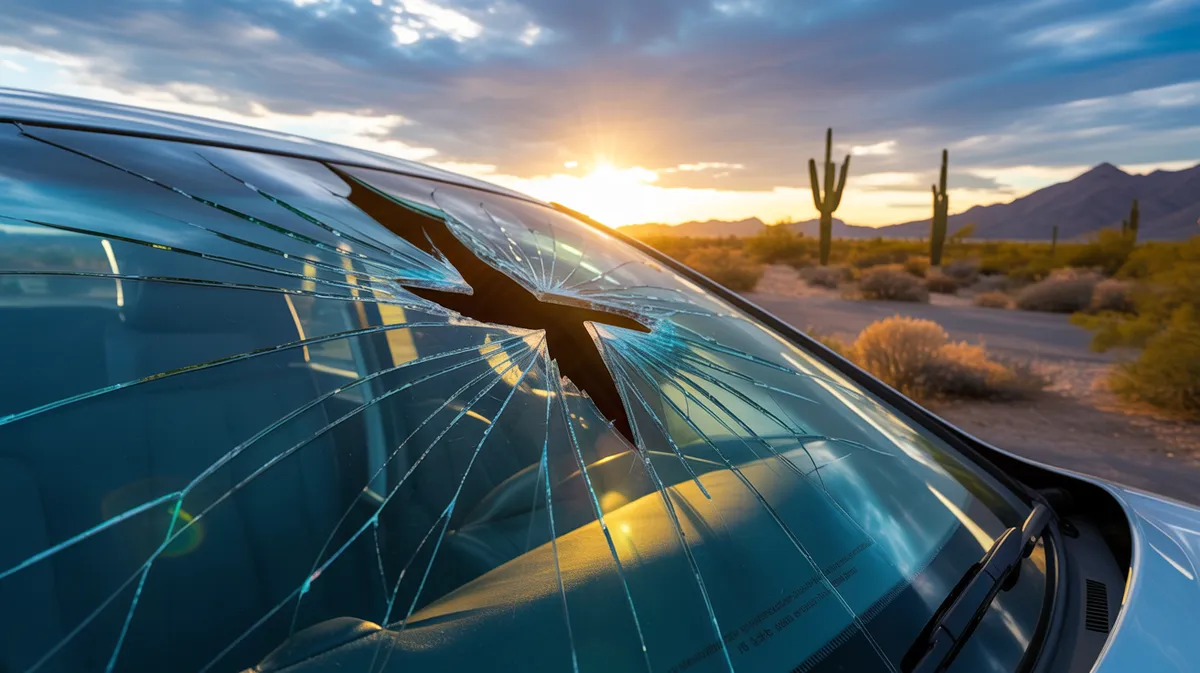
Valley driving is hard on windshields, and it's not a mystery why. Freeway gravel on I-10 and I-17 pits and chips glass constantly. Summer heat plus an air-conditioned cabin puts laminated glass through a thermal swing several times a day, which is exactly what turns a small chip into a spreading crack. Monsoon debris does the rest.
That changes the math. If your windshield has a realistic chance of taking another rock next spring, spending the OEM premium on a car that doesn't need OEM is a harder case to make. Conversely, the pitting that builds up over years of Valley freeway miles — that faint haze you only notice driving into a low sun — is a legitimate reason to replace glass that isn't cracked at all.
It also raises the value of acting early on small damage. A windshield chip repair takes about 15 minutes, preserves your original factory seal, and sidesteps this entire decision. When a chip can be repaired safely, that's always the recommendation we make first.
What to ask before you approve a quote
Whoever you call, these five questions separate a real quote from a number:
- Which category is this — OEM, OEE, or aftermarket? And which manufacturer made the glass?
- Does my vehicle have HUD, a forward camera, rain sensor, acoustic glass, or solar coating? A shop that can't answer this from your VIN hasn't looked.
- Does the quoted part support every one of those features?
- Is ADAS calibration included, and is it done in-house or subcontracted?
- What does my insurance actually allow? Some policies include an OEM parts endorsement; many default to OEE or aftermarket; a few approve OEM when the vehicle requires it. It varies by insurer, policy, and vehicle — so it's a question to answer, not assume. We work with all major insurers and file the claim for you, and we cover how the pieces add up in our Phoenix windshield replacement cost guide.
Our honest recommendation
Match the glass to the car, not to the price tier.
If you drive a HUD-equipped vehicle, or a car with a camera setup that's particular about what it looks through, get OEM or verified OEE and don't second-guess it. If you drive a straightforward vehicle without those systems, a quality aftermarket windshield is a smart, safe purchase and we'll say so — we'd rather you spend the difference on something else.
What shouldn't flex either way is the installation: correct urethane, correct prep, correct cure time before you drive, and calibration verified before you leave.
Not sure which category your vehicle falls into? Send us your year, make, and model or call (480) 525-0335 — we'll tell you exactly which features your windshield has to support, quote the right part for it, and get you a free estimate within two hours during business hours. We price-match valid written quotes, and if your car turns out not to need OEM glass, we'll be the ones to tell you.
Need auto glass service in Phoenix?
Free estimate within 2 hours, mobile service, and insurance handled. Let's get you back on the road.
Frequently asked questions
Yes. Any windshield legally sold for road use in the United States is laminated safety glass that has to meet federal glazing standards, and you can see the certification markings etched into the corner. Quality does vary between manufacturers, which is why the brand of glass matters more than the label 'aftermarket' does.
It depends entirely on your policy, your insurer, and sometimes the age of your vehicle. Some policies include an OEM parts endorsement, many default to OEM-equivalent or aftermarket glass, and some will approve OEM when a vehicle requires it. We work with all major insurers and can confirm what your specific policy allows before we order anything.
It can on some vehicles. The forward camera looks through a specific zone of the windshield and mounts to a bracket bonded to the glass, so bracket position and optical quality in that area both matter. Most of the time calibration completes normally. When it doesn't, the answer is different glass, not repeated attempts.