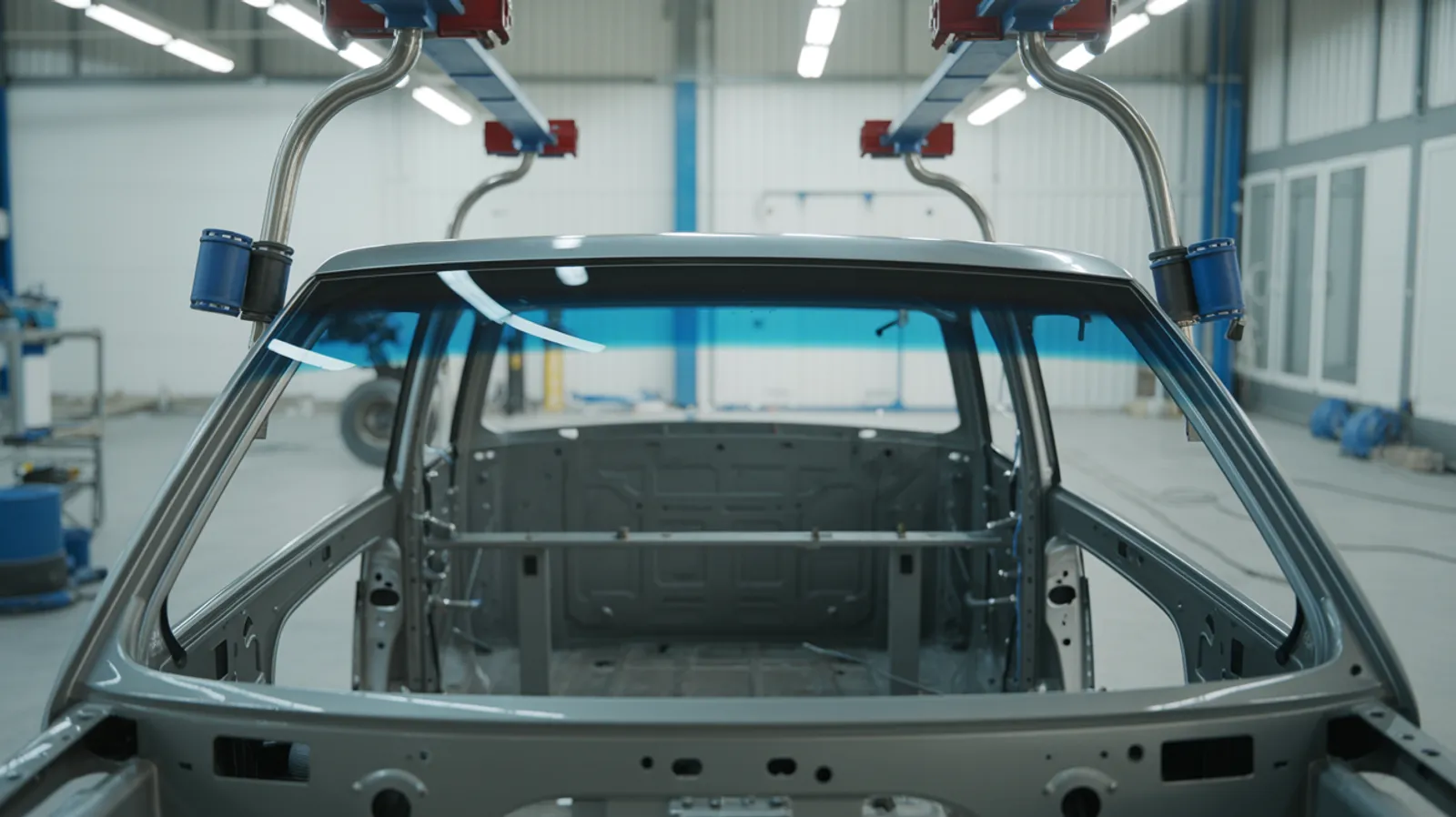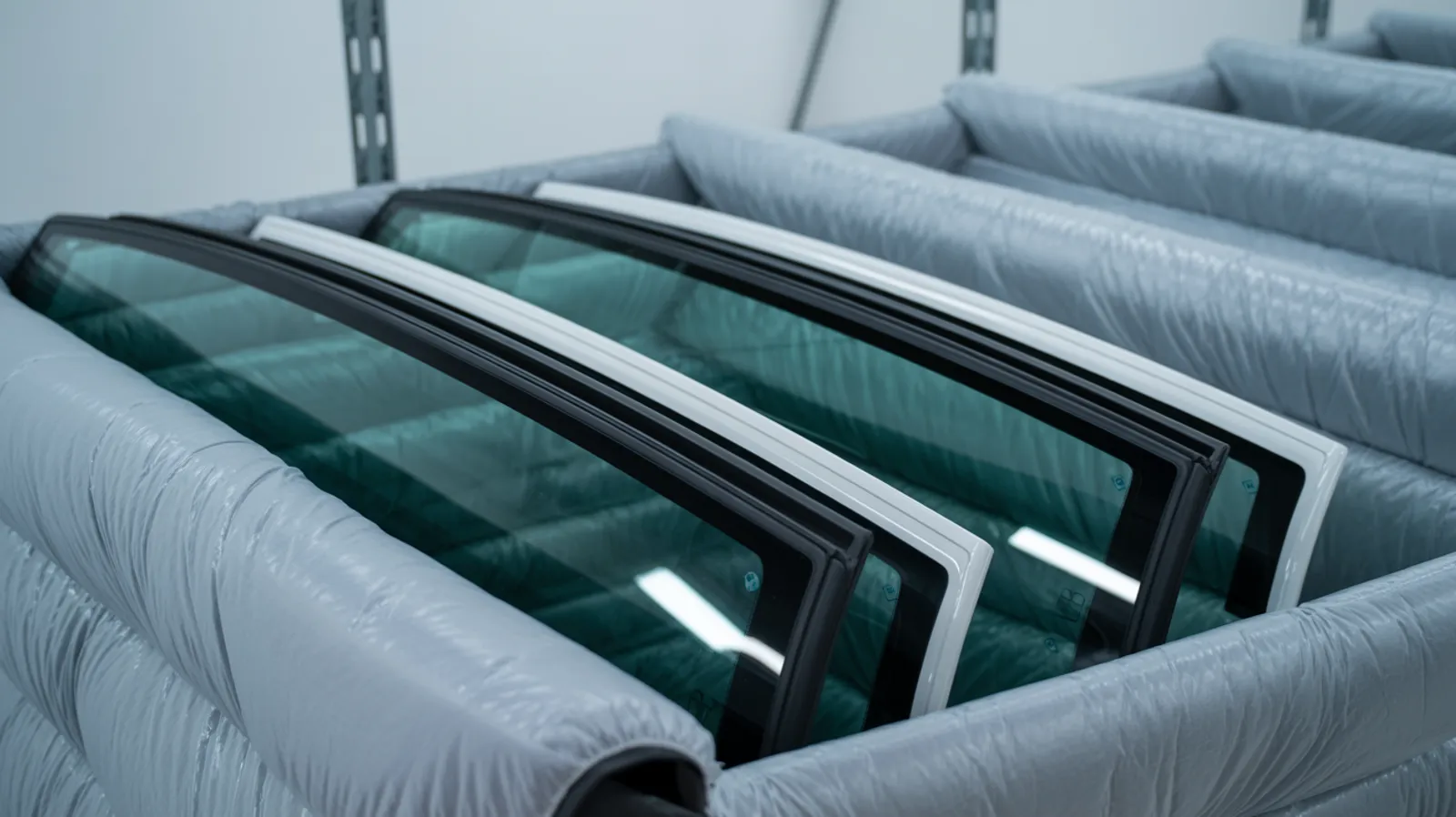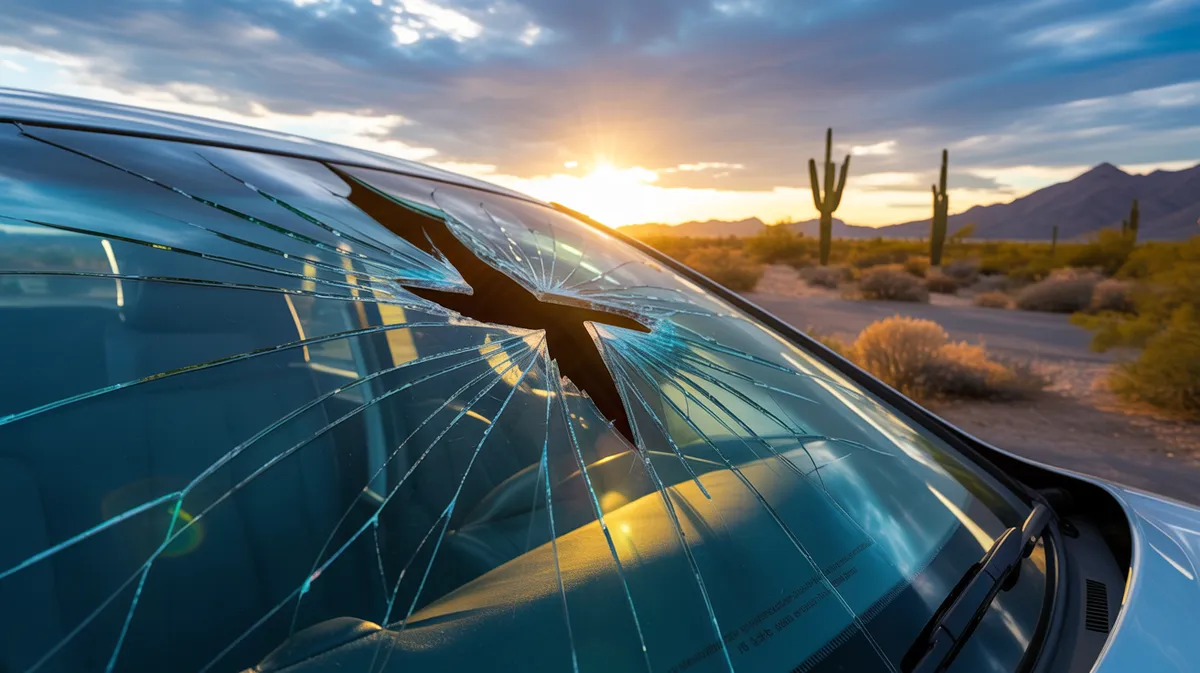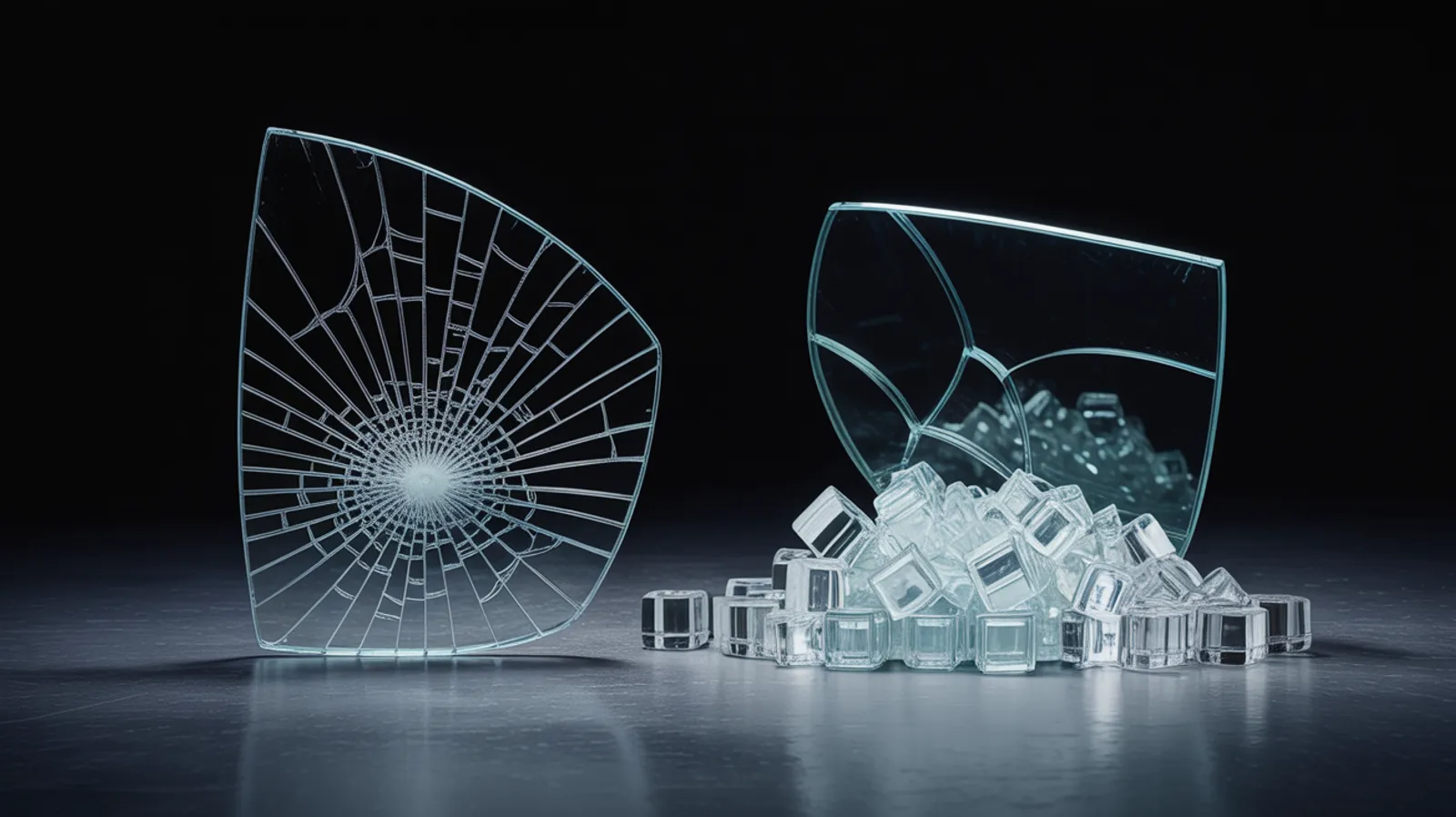
A windshield is laminated glass — two thin layers of glass bonded permanently to a clear plastic interlayer. Your side and rear windows are tempered glass — a single heat-treated pane engineered to break completely, all at once, into thousands of small blunt pebbles.
That one difference is the whole reason a chip in your windshield can often be filled in fifteen minutes, while a rock through your door glass means a new window, no exceptions. It isn't a shop policy or an upsell. It's what the two materials are built to do.
Laminated glass: built to crack and hold together
Windshields have been laminated for a long time, and the construction has barely changed in principle: glass, plastic, glass, fused under heat and pressure into a single sandwich. The interlayer is usually PVB — polyvinyl butyral — and it's what makes everything else about a windshield possible.
When something strikes laminated glass, the outer layer takes the damage. The interlayer absorbs the energy and, critically, keeps the broken pieces stuck to it. Nothing sprays into the cabin. The panel keeps its shape.
That matters far beyond convenience. A bonded windshield is a structural member of your vehicle. It helps support the roof in a rollover, it's the backstop the passenger airbag deploys against, and it's part of what keeps occupants inside the car during a collision. A material that vanished on impact would be useless for any of those jobs.
What laminated damage looks like
Because only one layer is usually affected, laminated glass produces damage you can point at and describe:
- Bullseye — a cone-shaped separation with a dark circular ring, typically from a blunt stone strike
- Star break — short legs radiating out from a central point of impact
- Combination break — a bullseye with legs running off it, the most common thing we see off Phoenix freeways
- Half-moon — a partial bullseye, usually from a glancing hit
- Edge crack — a crack that starts at or near the perimeter, where the glass is under the most stress
- Stress crack — a crack with no impact point at all, generally traced back to thermal cycling or a body flex
All of those have one thing in common: the glass is damaged, but the panel is still a panel.
Why laminated glass can be repaired
Here's the part most drivers have never had explained. A chip isn't missing glass. It's a void — a network of tiny separations now filled with air. Air and glass bend light very differently, which is exactly why the damage is so visible.
A repair works by pulling that air out under vacuum and pushing in a curable resin with a refractive index close to the glass itself. Once it's cured under UV light, the void is filled, the separation is bonded back together, and the light passes through more or less normally again. The damage stops spreading because there's no longer an air gap for stress to open up.
That process needs three things to be true: the inner layer of glass has to be intact, the interlayer has to be undamaged, and the break has to be the right type, size, and location. When those conditions hold, windshield repair is genuinely the better outcome — it preserves the factory bond, and a chip repair takes about fifteen minutes. When they don't hold, the honest answer is a full windshield replacement. Where exactly that line falls depends on the break, which is why we walk through it in detail in our guide to chip repair vs. replacement.
Tempered glass: built to disappear
Tempered glass takes the opposite approach. A single sheet of glass is heated to near its softening point, then chilled rapidly with jets of air. The surfaces cool and set first; the core cools afterward and pulls inward as it contracts. The result is a pane with its outer surfaces locked in compression and its center held in tension — a permanently stressed panel that is several times stronger than an ordinary sheet of the same thickness.
That stored stress is a bargain. You get a much tougher window. In exchange, you lose the ability to damage it a little.
What tempered failure looks like
There is no chip. There's no crack that sits still overnight. Once anything penetrates the compressed surface layer — a rock, a tool, a burglar's spring punch, sometimes just a chipped edge that finally lets go — the tension in the core releases across the entire panel in a fraction of a second. The window turns to gravel where it stands, and most of it lands in your door card and your seat.
This is by design, and the design is a good one. Tempered fragments are small and dull-edged instead of long and sharp. Just as importantly, tempered side glass is your way out: it's the window a first responder can break to reach you, and the window you can break to get out. A laminated pane on all four doors would be far harder to get through in an emergency.
You'll also see tempered glass fail with no obvious impact at all. That usually traces back to earlier damage at the edge of the pane — a nick from a careless install or road debris — or to a microscopic inclusion in the glass that finally expands. It looks spontaneous. It rarely is.
Why there's nothing to repair
Repair requires a panel. Tempered glass doesn't leave one. There's no intact substrate to bond to, no void to fill, and no partial damage state — the window is either whole or it's granules. Every broken door glass, quarter glass, vent glass, and tempered rear window is a replacement, every time, on every vehicle.
Side by side
| Laminated (windshield) | Tempered (side and rear) | |
|---|---|---|
| Construction | Two glass layers bonded to a plastic interlayer | Single pane, heat-treated under stress |
| On impact | Chips or cracks; stays in place | Disintegrates completely into pebbles |
| Partial damage possible? | Yes | No |
| Repairable? | Often, depending on the break | Never once broken |
| Main safety job | Structure, occupant retention, airbag backstop | Occupant egress, low-injury fragments |
| Typical service | Resin repair or full replacement | Replacement only |
The exceptions worth knowing about
The clean laminated-front, tempered-everywhere-else split is no longer universal.
Laminated side glass. A growing number of vehicles use laminated front door glass for cabin quiet and theft resistance. If your car has it, a rock strike may leave a chip rather than a pile of pebbles — and whether that chip can be repaired depends on the specific damage and the glass. Worth asking rather than assuming either way.
Laminated rear windows. Some vehicles now use laminated rear glass too, again mostly for noise. Most still don't.
Sunroof and panoramic roof glass. Commonly tempered, though some panoramic panels are laminated. If a roof panel goes, it goes the same way a door window does — completely — which is why sunroof glass replacement is a replacement conversation from the first phone call.
The etched marking in a lower corner of any automotive glass panel tells you which you have. If it's worn off or hidden by trim, we can identify the correct glass from your VIN before we ever touch the car.
What this means on an Arizona road
Phoenix drivers meet both materials constantly, and usually in different ways.
Laminated damage here is a slow-motion problem. A stone off a gravel truck on the I-10 or the 101 leaves a chip that looks stable — and then our thermal swings go to work on it. A windshield baking at well over 150°F on a summer afternoon, hit with max A/C, flexes hard right across that void. That's how a repairable chip becomes a replacement, and it's the whole argument for fixing chips fast in Arizona heat. Monsoon debris and freeway gravel supply the impacts; the heat cycle finishes the job.
Tempered damage is instant and it's usually a bad afternoon. Smash-and-grab through a door window, a rock off a dump truck into rear glass, a shopping cart in a lot on 7th Ave. There's no window of opportunity to act — you're calling for glass the same day, often with a car you can't safely leave parked. That's what mobile auto glass service exists for.
Two more things people learn the hard way with tempered rear glass. First, the defroster grid and any antenna elements printed on that panel leave with it, so the replacement has to be the right part, not merely the right shape. Second, any film on that window is gone — which means rear window tinting gets scheduled alongside the glass, not months later. Arizona allows any darkness on rear and back side windows, while front side windows must let more than 33% of light through and windshield tint is limited to non-reflective film above the AS-1 line. Those limits can change, so confirm the current statute before you commit to a shade.
And if the panel that broke was your windshield, the job isn't finished when the glass is in. Vehicles with a forward-facing camera behind the windshield need that camera recalibrated afterward — we handle it in-house with Autel equipment, typically about 30 minutes after the install, and our ADAS calibration guide covers why skipping it is a genuinely bad idea.
The rule, restated
If it's your windshield, there's a real chance it can be saved — and the chance shrinks every hot day you wait. If it's a side or rear window, the decision was made for you the moment it broke, and the only question left is how fast you can get the right glass installed.
Not sure which situation you're in? Send us a photo or call Glass Detail at (480) 525-0335 and we'll tell you straight — repair if repair is safe, replacement if it isn't. Free estimate within two hours during business hours, mobile service across Phoenix and Central Arizona, and a lifetime nationwide workmanship warranty on every install. You can see how that's gone for other drivers on our reviews page.
Need auto glass service in Phoenix?
Free estimate within 2 hours, mobile service, and insurance handled. Let's get you back on the road.
Frequently asked questions
Not once it's broken. Tempered side glass releases its internal stress all at once and disintegrates into pebbles, so there's no intact panel left to bond resin into. Replacement is the only option. The exception is laminated side glass, used on some newer vehicles, which can chip without shattering.
Look for the small etched marking in a lower corner of the glass. It usually lists the manufacturer, a DOT code, and the glass type — often the words laminated or tempered. If the marking is worn or the corner is blocked by trim, any auto glass shop can identify the glass from your VIN.
A rear window is rarely just glass. Most carry a bonded defroster grid, and many carry radio or antenna elements printed into the same surface. Those go with the broken panel and have to come back with the new one. Any tint film on that window is destroyed too and has to be reapplied.