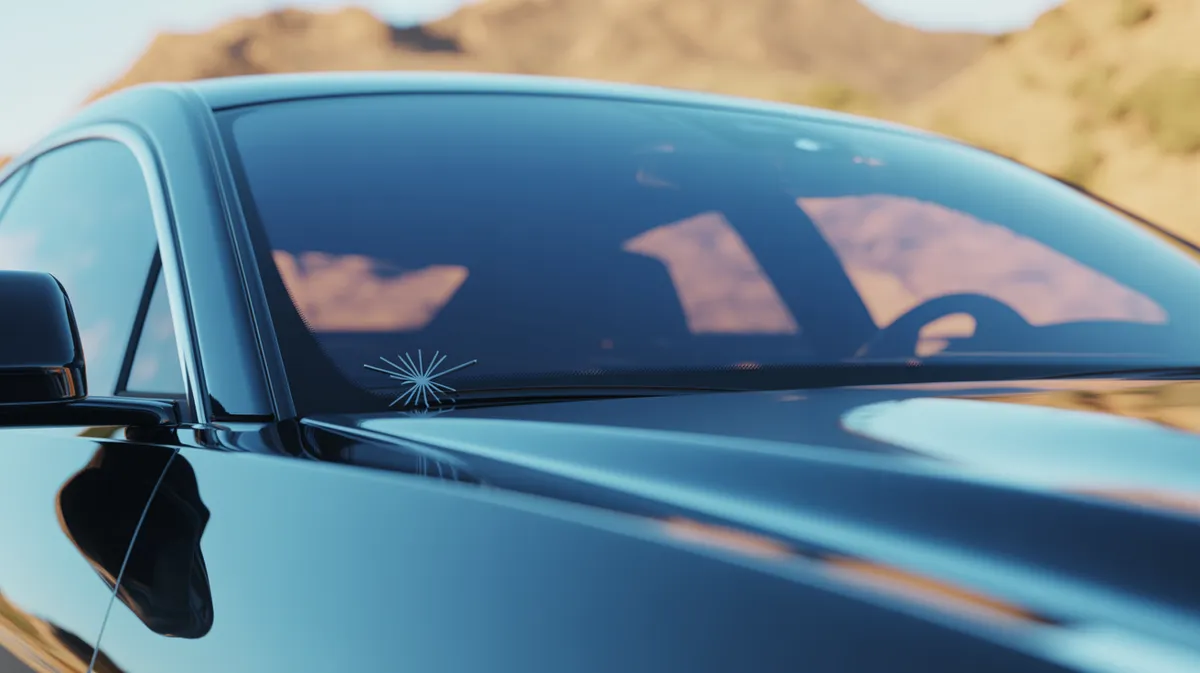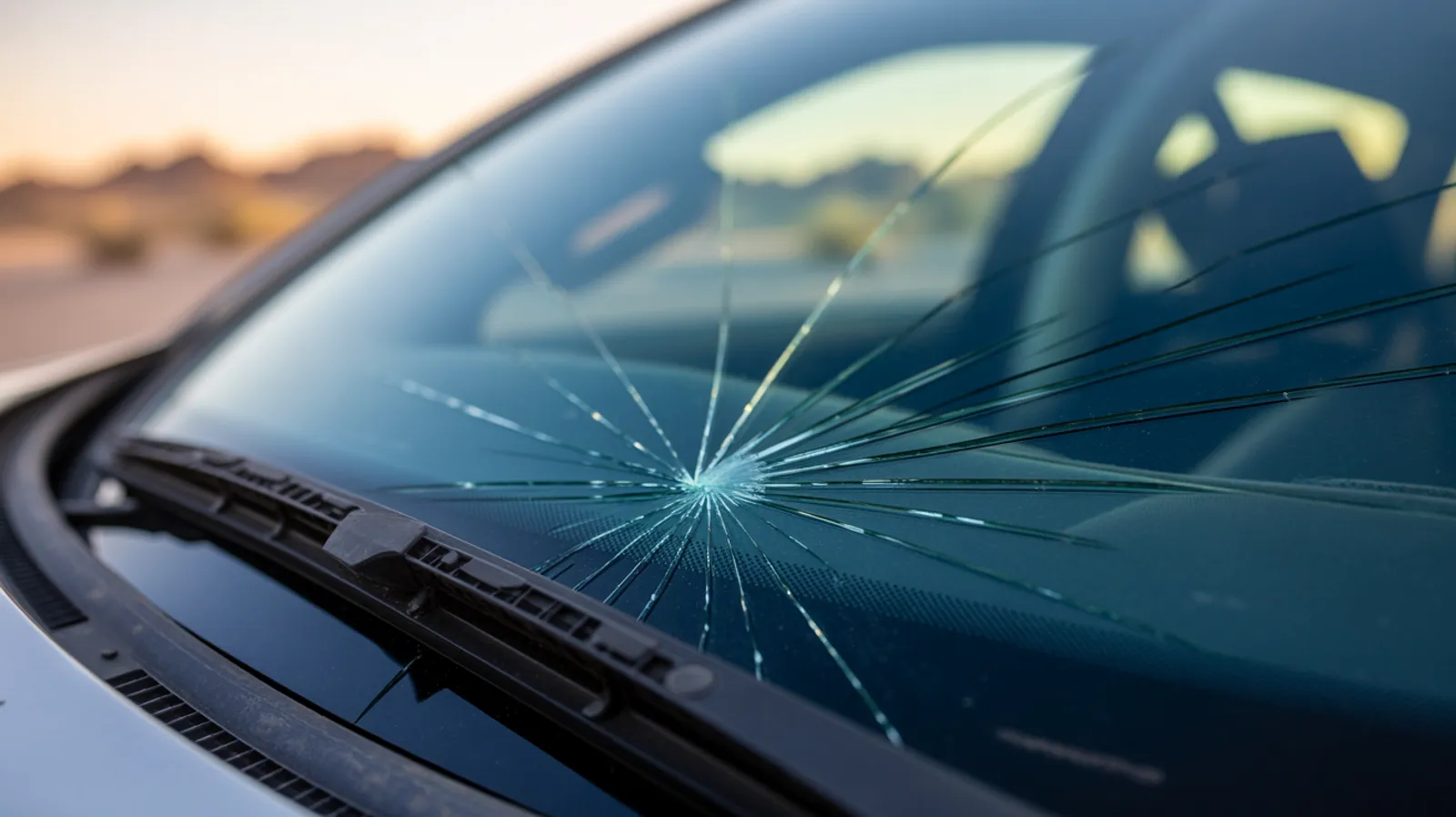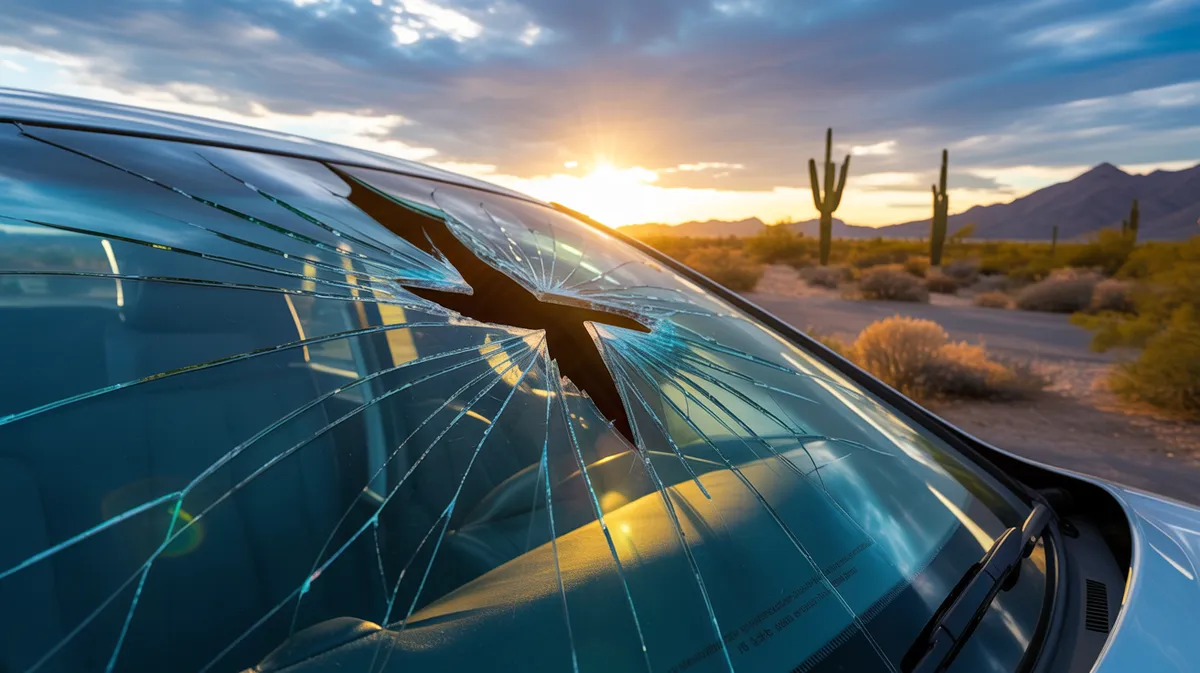
A single crack that's clean, shallow, out of your line of sight and not touching the edge of the glass is usually repairable when it's shorter than about three inches. From there to the length of a dollar bill — roughly six inches — it's a judgment call. Past a dollar bill, we stop repairing and start quoting glass.
But length is the check people over-weight. A two-inch crack can be an automatic replacement, and a longer one can be a straightforward repair, because four other things matter just as much. Here's the field test you can run right now, standing at your car.
The five checks that decide it
Pull a dollar bill and a quarter out of your wallet. That's the whole toolkit.
1. Length — measure it against a dollar bill
Lay a dollar bill along the crack. Under about half its length — roughly three inches — and repair is the likely call. Longer than the whole bill, and you're looking at windshield replacement. In between is where the other four checks decide it. For a chip rather than a crack, the quarter is the reference — if the whole break hides under a quarter, it's usually a straightforward chip repair.
These are shop rules of thumb, not law. Different technicians and different resins draw the line in slightly different places, and a well-equipped shop will attempt a longer crack than a mobile-only outfit will.
2. Location — where it sits on the glass
This is the check that overrides length. Damage sitting directly in the driver's primary viewing area is generally replaced rather than repaired, even when it's small, because a repair leaves a faint distortion and putting that permanently in front of the driver's eyes is a bad trade.
Two other locations complicate things:
- Behind or beside a windshield camera or sensor bracket. Repair resin in the camera's field of view can affect what the system sees, and manufacturers vary in what they allow.
- Near a rain sensor, heating element or antenna line. Not automatically disqualifying, but it changes the approach.
3. Depth — one layer or two?
Your windshield is two sheets of glass laminated to a plastic interlayer. Repair works on damage confined to the outer sheet. Once the inner sheet is cracked, resin can't restore it and the glass gets replaced.
The quick test: run a fingernail along the crack on the inside of the car. If you can feel it from in there, you likely have damage through to the inner layer. Feel it only from outside, and you're in repairable territory.
4. Edge proximity — how close to the frame?
A crack that touches or runs close to the outer edge of the glass is treated more seriously than the same crack in the middle. The edge is where the windshield is bonded to the body, and that's where the glass carries load — it's part of the vehicle's structure, backing your passenger airbag and supporting the roof.
Technicians generally eyeball a couple of inches of margin. Inside that margin, or running into the black frit band around the perimeter, most shops will recommend replacement. Edge cracks also tend to keep growing no matter how well they're filled.
5. Count — how many hits?
One crack is a repair conversation. Three or four separate breaks across the same windshield usually isn't, even when each one is individually small. Every repair is a spot of cured resin, and enough of them add up to a windshield with compromised optics and a weakened panel. There's also a practical limit to how many repairs are worth doing before new glass is the better value.
Quick reference
| Check | Leans repair | Leans replacement |
|---|---|---|
| Length | Under about three inches | Past a dollar bill, or still growing |
| Location | Passenger side, low corners, out of sight line | Driver's primary viewing area |
| Depth | Outer layer only | Felt from inside the car |
| Edge | Well inside the glass | Touching or near the perimeter |
| Count | One, maybe two | Three or more |
Every row leaning repair? Good odds. One row leaning replacement is usually enough to decide it — the checks aren't a score you average, they're gates.
The honest caveat: an inspection decides
That table gets you close, but no one can quote a final answer from a description or a photo alone. What a technician evaluates in person that you can't:
- Contamination. Dirt, wax, glass cleaner and car-wash soap wick into an open break. A crack that's been open for weeks may not accept resin well enough for a lasting repair.
- Moisture. Water in the break has to be driven out first, and monsoon-season damage often arrives wet.
- Break type. Star breaks, bullseyes, combination breaks and long stress cracks each behave differently under resin, and the legs coming off a star break can matter more than the crack's overall length.
- Whether it's already moving. A crack that has visibly grown in the last few days is telling you something about the stress in that panel.
- Your vehicle's requirements. Some manufacturers are specific about repairs near driver-assistance camera zones, and that guidance is vehicle-specific rather than universal.
- Your insurer's position. Coverage for glass varies by policy and carrier, and it can influence which option makes sense for you. We work with all major insurers and file the claim for you, so the answer to that part is one phone call.
We'd rather tell you a repair won't hold than take your money for one that fails in August. If the honest call is replacement, we'll say so, and the reverse is just as true — we'll talk you out of new glass you don't need.
What Arizona does to the math
Everything above shifts faster here than it does in most of the country.
A windshield parked in a Phoenix lot in July gets brutally hot, and then you get in and hit max A/C. The inner surface contracts while the outer surface is still baking, and that gradient pulls on every existing break. A crack you measured at four inches on Tuesday can measure seven on Friday without you hitting a single pothole. That's why the "how big" question has a shelf life — the crack you're looking at right now is the smallest it will ever be.
Add the gravel that lives on I-10 and the Loop 101, monsoon debris, and dust storms that sandblast glass, and Arizona windshields collect damage faster and lose the repair window sooner. We wrote more about that stress cycle in our guide to how Arizona heat spreads windshield cracks.
Practical version: if you're on the fence, decide today rather than next month. And if you want the full repair-versus-replace framework beyond crack size, our chip repair vs. replacement guide covers the whole decision.
Keep it repairable until your appointment
Three things buy you time:
- Cover it. Clear tape over the break keeps dirt and water out. Don't put tape adhesive directly into the damage if you can avoid it — cover it, don't pack it.
- Stop the thermal shock. Park in shade or use a sunshade, and cool the cabin gradually instead of blasting cold air at a sun-baked windshield. Never pour cold water on hot glass.
- Reduce flex. Skip the automatic car wash, take it easy over rough pavement, and close doors gently — cabin pressure spikes push cracks along.
What each outcome actually looks like
If it's repairable, a crack repair is quick. Resin is injected, cured and polished flush, the damage stops spreading, and you're back on the road — chip repairs run about 15 minutes and cracks take a bit longer depending on length and type. Our full windshield repair service covers both.
If it's a replacement, plan on about an hour for the install plus adhesive cure time before it's safe to drive. That cure window depends on the specific adhesive and the conditions that day, and your technician will give you the real number rather than a guess. If your vehicle has a forward-facing camera, we handle ADAS recalibration in-house with Autel equipment, typically around 30 minutes after the install, so you leave with lane-keeping and emergency braking aimed correctly. Installs carry a lifetime nationwide workmanship warranty, and your first chip repair is free with a windshield replacement.
Either way, we come to you. Mobile service covers Phoenix, Scottsdale, Tempe, Mesa, Chandler, Gilbert, Glendale and Peoria — see the full service area map — or bring it to the shop at 2910 N. 7th Ave.
Still not sure which side of the line you're on?
Run the five checks, then let us confirm it. Text a photo of the crack or call (480) 525-0335 and we'll get you a free estimate within two hours during business hours, usually with next-business-day service. If it's repairable, we'll tell you — and if it isn't, we'll tell you that too.
Need auto glass service in Phoenix?
Free estimate within 2 hours, mobile service, and insurance handled. Let's get you back on the road.
Frequently asked questions
Our rule of thumb is a single crack shorter than about three inches, when it is clean, shallow and away from the edge. Between that and the length of a dollar bill, roughly six inches, it becomes a judgment call. Longer than a dollar bill and repair is off the table. Length is only one factor though — a two-inch crack at the edge of the glass is usually a replacement.
No. Resin repair is a structural fix, not a cosmetic one. It bonds the glass back together and stops the crack from running, but a faint line usually remains and is more visible on a long crack than on a small chip. If a flawless view matters more than saving the original glass, replacement is the honest answer.
Usually yes for a short crack away from your sight line, but treat it as temporary. Avoid rough roads, car washes, cold water on hot glass, and slamming doors, since pressure changes make cracks run. If the crack crosses your line of sight or is spreading while you watch, get it handled before your next long drive.